Mapping Metro Manila Fires: The Past 10 Months of TXTFIRE Alerts
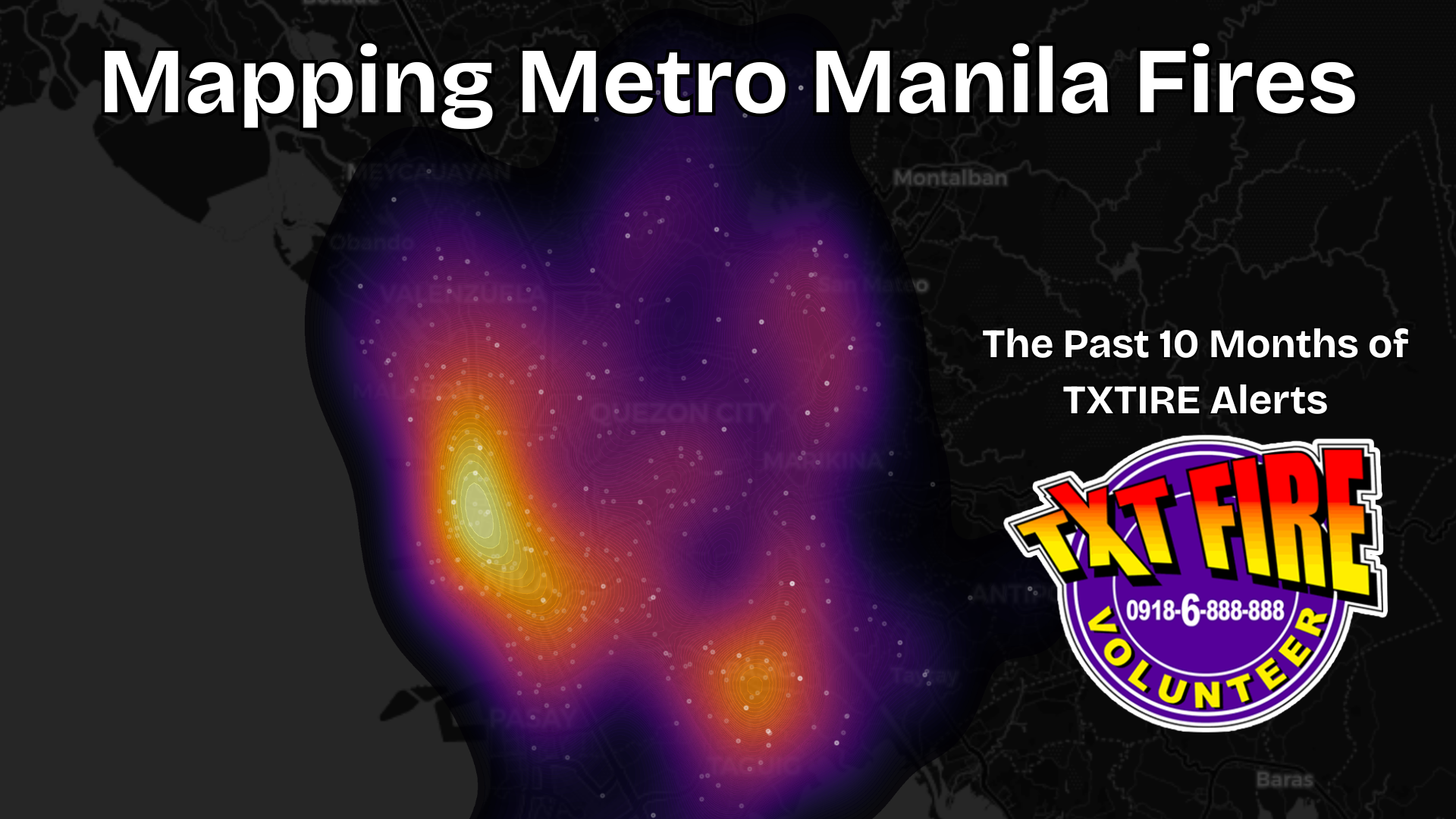
Spatial density of 724 TXTFIRE-reported fire incidents across Metro Manila from July 2025 to May 2026.
Over the last 10 months, TXTFIRE Philippines broadcasted more than 2,702 fire-related alerts across 724 unique fire incidents in Metro Manila.
Metro Manila is the urban region surrounding the Philippine capital city, Manila, and is the most densely populated region in the country, with roughly 22,000 persons per square kilometer. [1] Within its borders, homes, businesses, and informal settlements exist side-by-side, making emergency response times fragile to mere seconds. [2]
Electrical faults, overloaded circuits, and unsafe wiring are the leading causes of fires in the Philippines, according to the Bureau of Fire Protection (BFP). [3]
BFP has acknowledged its shortage of personnel, making volunteer firefighters essential for the safety of the region. [4] Despite their invaluable impacts to the community and the dangers they face, volunteer firefighters rely on donations of PPE and do not receive funding from the government. [5]
To combat the risks of fire across Metro Manila, TXTFIRE connects local fire stations and volunteer firefighters to coordinate rapid response and protect their communities.
Disclaimer: The analysis and visualizations to follow underestimate the true number of fires occurring across Metro Manila during the observation period. TXTFIRE data were collected from publicly available Facebook posts and contain gaps related to incomplete archival capture or periods of reduced posting. As a result, this work represents a lower bound of fire activity rather than a census of fires in the region.
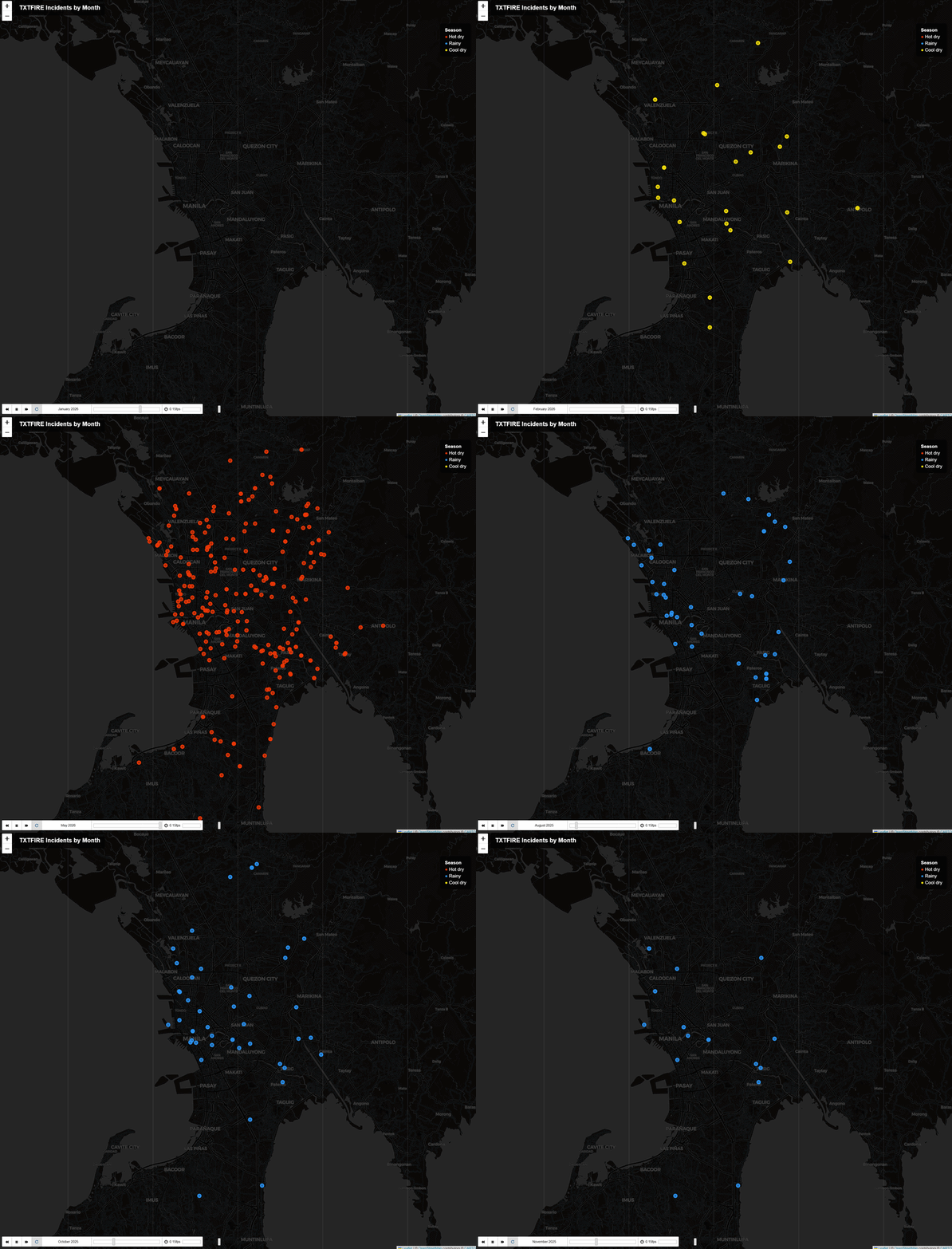
TXTFIRE-reported fire incidents across Metro Manila over the last 10 months, transitioning through the Philippines’ cool dry, hot dry, and rainy seasons.
Nearly 70% of observed incidents occurred during the Philippines’ hot dry season (March–May), when Manila experiences some of its hottest weather of the year, with average daytime highs exceeding 32°C (90°F). [6] Fires erupt typically in the afternoon (40%) or at night (37%).
TXTFIRE communications are short posts, simply stating where the fire is and its status. Most incidents are first posted for verification. Then, status updates follow with how many buildings are affected (“alarm level”), and later, if the fire is under control. Only 6% of incidents were broadcasted as false alarms.
Fires on average last 10 minutes, with longer fires burning on for over one hour. As a result of the efforts by the BFP and volunteer brigades, 63% of fire incidents are broadcasted as “under control” or “fire out” within 30 minutes.
Fire activity varied across Metro Manila cities and neighboring municipalities. Quezon City, the largest city in Metro Manila, had 138 recorded fires during the observation period, often extinguished within 13 minutes. Manila, the smaller historic city, had 196 recorded fires but were extinguished within 5 minutes on average, quickly preventing further spread. In neighboring towns, TXTFIRE reported 32 fires persisting for 25 minutes on average.
Manila, Navotas, Malabon, and Caloocan — cities representing the lowest 25% of household wages according to the 2023 Family Income and Expenditure Survey — experienced approximately 30 fires per month, though incidents tended to resolve quickly with a median duration of roughly 5 minutes. In contrast, cities such as San Juan, Makati, and Pasig, which represented the highest wage quartile, experienced fewer monthly fires (18 per month on average) but longer-lasting incidents with median durations closer to 14 minutes.
The map above shows where fires threatened communities across Metro Manila over the last 10 months. Behind each coordinate were firefighters and volunteer brigades racing to protect homes, neighborhoods, and lives.
Sources
Data Source: TXTFIRE alerts were collected from publicly available Facebook posts from July 16, 2025 through May 22, 2026.
[1] Philippine Statistics Authority Regional Statistical Services Office NCR. Highlights of the National Capital Region Population: 2020 Census of Population and Housing.
https://rssoncr.psa.gov.ph/content/RSSO/highlights-national-capital-region-ncr-population-2020-census-population-and-housing-2020
[2] TXTFIRE Philippines. Our History.
https://txtfire.net/our-history/
[3] GMA News. Electrical issues remain most common cause of fire, says BFP.
https://www.gmanetwork.com/news/topstories/nation/937689/electrical-issues-remain-most-common-cause-of-fire-bfp-data/story
[4] GMA News. BFP-NCR: Fire incidents up over 13% in January–July 2024.
https://www.gmanetwork.com/news/topstories/metro/916225/bfp-ncr-fire-incidents-up-over-13-in-january-july-2024/story/
[5] KMJS / YouTube Documentary on Volunteer Fire Brigades in the Philippines.
https://youtu.be/r7LmKQsUhZQ
[6] Weather Atlas. Average March Weather in Manila, Philippines.
https://www.weather-atlas.com/en/philippines/manila-weather-march
[7] BIGWAS. BFP Fire Alarm Levels Explained.
https://www.bigwas.com/2025/01/bfp-fire-alarm-levels.html
[8] Philippine Statistics Authority (PSA). Housing Characteristics in the Philippines: 2020 Census of Population and Housing.
https://psa.gov.ph/content/housing-characteristics-philippines-2020-census-population-and-housing
